Thursday, November 19, 2009

Cataiku


Lonely panther hunts;
A pride of lions kills daily;
I demand a treat!

The bird of time flies;
Its nest holds tasty meat snacks.
Time. It. Is. To. Feed!

You ignore your cat?
Your hands pet keyboard, not me?
Now I leap toekwtypsypsmishtgytsdsSSSDZXSZZ!!!!!!!!!!!

Wednesday, November 18, 2009

Washington State's Alliance for Equal Justice

tThe Alliance for Equal Justice of Washington State is an umbrella network of all civil legal aid programs in the state, formed in 2004 to create efficiency, provide support, and foster collaboration among members.
Alliance members are organizations whose predominant mission is to provide civil legal aid to Washington State’s low-income and vulnerable people. There are two basic kinds of member organizations: legal aid programs, and volunteer programs.


Legal Aid Programs
The Alliance includes a number of statewide and specialty legal aid programs. Some are general practice programs; others help low income populations who face unique barriers to our civil justice system or provide representation related to specific types of legal problems. Several programs provide services to individuals and families across the state.


Through statewide planning with one another, the pro bono programs, and Alliance supporters, these programs create efficiency by ensuring services are not duplicated and that legal assistance is available to some of our state's most marginalized populations.

Volunteer Programs

Thousands of lawyers in Washington provide their time and expertise to make access to justice a reality for low income and vulnerable members of our community. 

Pro bono efforts are coordinated through local bar association volunteer lawyer programs throughout the state as well as in law firms, governmental law offices, and corporate counsel offices. Volunteer lawyers provide a continuum of services from brief advice in clinics to extended representation in court.

Commentary

Most of the above text is straight from the Alliance's website.

This praiseworthy effort does not seem to flaunt on its site any strategic vision. It recognizes that "Over 650,000 low income people living in Washington went without any help when they faced serious civil legal problems this year" but does not offer any plan to solve the problem of making "access to justice a reality" for that 650,000. It has a list of things it does, and they are all very good things; but  the magnitude of the uncompleted tasks is never compared to the resources marshaled to address them. It has a very wordy yet number-challenged plan (2008) which assumes that the Legislature is going to provide funding where there isn't enough pro bono volunteers; there is very little in the historial record to suggest that this will, in fact, occur. The website talks about the work it does and anecdotes about the success it has achieved; it avoids the topic of the work left to do and how it will achieve it. This is rolling out an aircraft that has yet to fly, without a plan for it to take wing. What a pity! the problem is inherently solvable, although basic math suggests that a comprehensive solution requires projects in addition to those within the Alliance's evident contemplation.

Among these means may be:
  • Training members of the underserved community to provide legal services, either by funding law school or systematically expanding the Rule 6 program (In the long run, the best means of providing an underserved community with something is to empower the community to provide for itself or in cooperation with other communities. Every other approach merely perpetuates inequality.)
  • Educating members of underserved communities to avoid legal issues or, when possible, to steer their way out of them, through Public Legal Education and comparable programs
  • Systematically coordinating efforts with other legal professionals, such as paralegals, legal secretaries and other
  • Reforms to laws and rules, to facilitate pro se and other access to courts
  • Improving means of funding legal aid programs, to eliminate dependence upon the inherently unstable IOLTA
  • Other means; above all, a plan, however voluntary, to close the Justice Gap, using every means available.
It's worth noting also that "equal access to justice" does not promise a particular outcome in any particular care or class of cases. For example, in your garden-variety landlord/tenant matter, sometimes the law and facts are on one side, sometimes on the other; the goal of equal access to justice is to give all parties an equal shot to have the matter decided on the merits.
This is to be distinguished from social justice, which can relate more to outcome than to process. The distinction maybe helpful for enlisting a broader range of support, since some persons reluctant to address social justice issues that may disadvantage themselves personally may nonetheless be totally in agreement with our foundational American vision of Equal Justice Under Law.

Sunday, November 15, 2009

I Can't Complain, Although I Want To

I've had good luck and I've had bad luck. Good luck is better!
In my career, I've been screwed over several times, but I must in honesty admit I've also had some unreasonably good luck. In my case, things have more-or-less worked out even.

My first good job was back when people were just getting over the idea that programming had to be on punch cards, and structured programming was still controversial. (Not to me, but to people who just didn't Get It!) If you don't know what structured programming is, think of it as the invention of cellular life; before it, our loose and unstructured coding protoplasm wandered messily all over the place and died mysteriously.

I moved from Michigan to Pelham, Massachusetts possessing several years of programming experience, but had no luck finding work. Partly this was because I was living in a small college town where there was an oversupply of students competing with me. I also didn't want to take a pay cut from what I'd earned in Michigan, little appreciating that my resume and professional appearance was not helpful. (All those people who tell you appearance doesn't count, it's what's inside that matters, knew nothing about looking for work.) Armed with an unrealistic view of my marketability, and knowing nobody actually working for pay in my field, I turned down a couple of offers that I now know were actually reasonable.

Finally, I got an interview at Coleco Industries, in Hartford. This was a grossly excessive commute, but I was out of options, so I went to the interview with the project manager named Ray. Now I'm not going to say anything bad about Ray; I like Ray; he was very outgoing and if he didn't have the greatest technical skills in the world, he was never nasty. If I could make something work, that's all that really mattered to him; what else do you want?

But our first interaction was a screw-up. At the interview, Ray asked if I knew anything about transaction programming. Sure, I thought, I knew what a transaction is. You know, it's like cashing a check. And I knew about programming. So I said yes. And so I got the job.

It turned out that we had both fooled ourselves and each other. Transaction programming was a specialized field, sort of like pre-internet page serving with some database access thrown it. It wasn't that hard to pick up, so maybe Ray never knew we'd mutually b.s.'d each other. Maybe it didn't matter, since it all worked out.  Maybe the supply of programmers was tight in Hartford, with the big insurance companies vacuuming up all the talent. Or maybe Ray could never admit a mistake.

At any rate, through this lucky accident I got a gig which was still the best job I ever had. The working conditions were good, the pay and bennies fine, I had lots of friends and respect for the knowledge I had crafted. (I would still be working there today, if the company hadn't gone bankrupt, but that's another funny story...)


I like to think of that job interview, when I am reminded of the times I was screwed over. For certain organizations, I have sacrificed a lot; in return, I've been treated like a used tissue - not even recycled! Now, this has been not everywhere and everytime; I can name some good organizations and great bosses too but, frankly, technical merit and business success has too often been the least important features of too many projects. This would annoy any normal person but, since my entire programming career depended on that one bit of unreasonably good luck, how can I complain when the dice run cold?

Don't we all like to think that anybody can succeed with hard work, good planning, skill and determination? Don't we all know this is horseshit, although (like a steaming manure pile), sometimes it's your only source of warmth on a cold wintery day? Anyone will find it easier to succeed with work, planning, skill, determination and a bit of horseshit, but as Stephen Schwartz writes in Pippin:
"Now listen to me closely I'll endeavor to explain
What separates a charlatan from a Charlemagne
A rule confessed by generals illustrious and various
Though pompous as a Pompey or daring as a Darius
A simple rule that every good man knows by heart
It's smarter to be lucky than it's lucky to be smart"
And with that cheery thought ... good night and good luck!

Saturday, November 14, 2009

The Healing of America: Why Fear Learning from Our Friends?

If you never saw the ocean, you might think your local swimming hole is a pretty big body of water.

That's the problem with people who think our American health care system is the best in the world: they have never gone to see if anything is better.

Pride in your local swimming hole is harmless, but health care is life and death. Only an arrogant fool would think that THEY know all the answers, and cannot possibly learn from our friends in Germany, Japan, France, Canada, India and the U.K.. A wise man would go there, try their system, and see what ideas we can borrow for ourselves.


In "The Healing of America: A Global Quest for Better, Cheaper, and Fairer Health Care", T. R. Reid does every American a great big favor by taking his bad shoulder around the world to be looked at by doctors in six countries. What he finds will surprise anyone who thinks the rest of the world is a socialist hell, burdened by grey bureaucrats staffing drably uniformed Death Panels. He finds is that each of those nations has a different system, tuned to their particular histories, and with strengths and weaknesses. Most are dominated by private suppliers, e.g. doctors who run their own offices. I was shocked to discover that, on average, Japanese visit doctors more than twice as often as Americans; France's information technology makes ours look like a joke; even in much-maligned Britain people's lives are saved because there is no financial barrier to coming to the doctor if you have a suspicious lump. Why are Americans afraid to learn these basic facts? Why not take their ideas to improve our system? Are we just too proud to live?

I suppose pride is part of the problem; the other is that Our existing system has enormous institutional inertia. As Machiavelli said those few who reap great profit from some affair can easily defeat a vastly greater number who have a more diffuse interest. In providing an actual experience of seeking health care around the world, this book suggests that our current arrangements are not the best; but of course, they are the best to those it enriches.  Reid tries to demonstrate that inertia can be overcome, by describing how Taiwan and Switzerland converted their systems around the time that the Clinton initiatives failed. I suspect, unfortunately, that our American system will be a trickier conversion, because the forces arrayed against reform learned from Taiwan and Switzerland, and will fight to keep what they've got; you cannot take a juicy steak away from a pack of hungry dogs without getting bitten.

If you're in a hurry, you will appreciate that this book is a quick read. While it's got plenty of footnotes so you can verify the assertions and learn more, its organization lends itself to grabbing a quick chapter while you can. I especially enjoyed the chapters about each nation; they were like a short story of a visitor seeking help and happened when he did.

However, I found the most surprising chapter entitled "An Apple A Day", which discusses why our current system works against preventative measures. Since your insurer as a youth will not be your insurer in old age, the former has no reason to do anything that would benefit only the latter. If a private insurer can put off dealing with a problem until the patient turns 65, the private insurer may not have to deal with it at all! It is a perfect example of how what is economically efficient in individual health PAYMENT transactions results in systemic inefficiency in the overall health CARE system.

However, the most important chapter may be "The First Question". Ultimately health care is not a financial question; it is a moral question. What kind of nation are we? What kind of people are we?

If we are content that a woman shall live or die depending solely upon whether she is the president of a company or its minimum-wage floor-mopper, then we need do nothing. We have that system already. Of course, we can't be very proud of that; it's basically a return to the hells of Upton Sinclair.

If, however, we are a more decent people, we believe that all of us should have a good chance at life. Life is not a luxury to be reserved, but a necessity to be shared by to all members of our community. And, best of all, as this book shows, we have friends in other nations who can show us how they did it.

It's our choice.

What are we?

Friday, November 13, 2009

Dusting Lightbulbs for Fun and Profit

In response to this week's Change the World Wednesday Challenge:
"In most homes there are multiple light bulbs used to light a single area. For example, bathrooms usually have a row of vanity lights ... ceiling fans often have three or more light bulbs ... and kitchens typically have quite a few lights (over the sink, over the table, over the center of the room, etc.). So, this week, twist off all but one bulb in each area and see if it works for you. If one bulb isn't enough light, twist on a second ... or a third. The idea, here, is to experiment a little, use only the amount of light that is truly necessary, and save a lot. So, twist them off!
So I took a look at our bathroom lighting.
Six bulbs, one that burned out a while back; since we never bothered replacing, clearly we didn't need it.

I unscrewed the one of those left (!Basta! that's HOT!) and the result seemed o.k. We'll try it for a week and, if there's a problem, screw it back in again. Experimentation is fun!

I noticed the top of the bulb was dusty. That dust is dysfunctional from a lighting standpoint; it coverts light to heat, not only absorbing maybe 5-10% of the light but also heating up the bulb, shortening its life. So by dusting the tops of the 4 bulbs left on, I increased their output, getting FOR FREE the equivalent of another half-a-lightbulb. It's not massive wealth but hey, let's take what we can get!

If we owned this place, I would install a inexpensive mirror strip behind and above the bulbs, to cut the light wastened in bouncing off the wall and ceiling. For that matter, by the time we can afford a home of our own, lightemitting strips will be cheap enough for home use.

But for now: dust those light bulbs to save money AND our planet!

Wednesday, November 11, 2009

Veterans Day: Our Responsibility

Can you think of a better way to honor our veterans on Veterans Day than to reduce or eliminate the need to make more of them?

We civilians send them to kill and to die for us; their actions are our actions and the consequences of those actions are our consequences. We like to duck and deny those consequences because, you know, they're expensive. At the same time, we feel the need to increase those consequences; we feel the right to order our servicemembers to go anywhere and kill anybody that we decide is a threat to us or to "our interests". Our interests include anyone we decide is our friend, no matter how awfully they treat their neighbors or their subjects, and our economic system. We are, in a word, arrogant.

We civilians are the ultimate Pointy-Haired Boss.

So on this November 11, let us wax sentimental about those we send in our name to do our killing for us. Give them nice uniforms and nice speeches and the most expensive equipment money can buy (whether or not there is a military need for it.) Let us spend hundreds of billions of dollars on airtankers to protect us against ragged men with AK-47s who aren't entirely clear on whether the Earth is round. Let us spend trillions of dollars on flotillas that burn huge amounts of oil, to protect our access to oil (which is sold into a world market.) Let us spend more money than all the rest of the earth put together protecting "our interests", as defined by the corporations that make the flotillas, airtankers, and possibly even the AK-47s.

But when it comes to "serving those who served", let us be economical. While our VA gives pretty good care for service-connected injuries, when it comes to matters than cannot be proven connected to service, we treat our veterans like every other American: badly. Our one-time foes Germany and Japan treats their every citizen better than we treat our veterans when it comes to ordinary medical care.
“On this Veterans Day we should not only honor the nearly 500 soldiers who have died this year in Iraq and Afghanistan, but also the more than 2,200 veterans who were killed by our broken health insurance system. That’s six preventable deaths a day." - Public Health, Nov 10, 2009
Likewise, when it comes to higher education opportunities for our veterans, even with the new GI Bill, are inferior to that offered every civilian in Western Europe. And housing? Transportation? Legal aid?

If we don't think we can afford to treat our veterans well, maybe we should consider being just a little less arrogant in the world. Then we'd have fewer injured veterans to heal, and need fewer troops to protect our "interests".

So let us honor our veterans on Veterans Day with ceremonies and speeches. Then let us decide whether we are just all talk.

==========

See also: Warriors for Peace portrait series

Tuesday, November 10, 2009

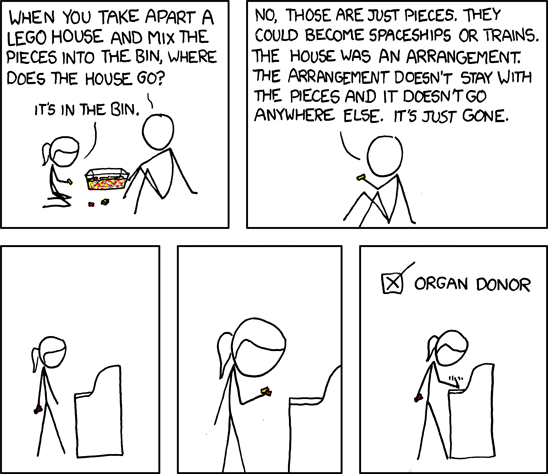
XKCD on Mortality

One of the most thoughtful writers currently in print is Randall Munroe's XKCD. For example:


My sentiments exactly.

See more:
http://www.xkcd.com

He's even got a reasonable licensing/re-use policy!

Monday, November 09, 2009

Why Abortion Trumps the Gospel for Rightwingers

David Brin (best known as one of the great SF writers of our current era, but also a keen social commentator) recently analyzed to why abortion is a perfect issue for rightwingers who are afraid of Jesus' essentially socialist message of social justice. Brin's deconstruction is completely consistent with my experience as a young seminary student, circa 1970, agitating on command against the pro-choice Referendum 20 in Washington State.
BRIN:
"... Which brings us back to abortion. My own theory is that this issue became so bilious and rage-drenched because of "The Jesus Factor."

Look at Jesus. Read his words. Tell me, whose side would he be on, in the argument over health care reform? Or taxation? Or welfare, or helping the poor? C'mon, it's embarrassing. He looked like a hippie, talked like a socialist and said that camels could pass through needles before rich dudes could enter heaven. The nagging question of "whose side would He be on?" was a truly vexing one, if your side always seemed to favor the wealthy and powerful. Even if some particular issue actually favors your conservative position, with logic and reason and Adam Smith on your side -- (hey, it could happen!) -- Jesus is still a pretty potent figure, standing over there with the socialists!

What was needed was a deal-breaker. A way to re-take the moral high ground. Ideally, a simple on-off switch that could be flicked once, and then left running, requiring no further anxiety over ethics and such. ANd requiring no further effort or money out of your pocket. The need? Find one issue so important that Jesus would HAVE to side with you, even if he disagrees with you over everything else.

Killing babies.

Yep. That'll do. Take a blatantly analog situation and mark it out digitally, as a perfect, binary on-off state. Define any fetus, embryo, even four-cell blastocyst, as a precious and totally reified baby. Pose your opponents as baby-killers and Jesus will have to side with you, even if he holds his nose over all the other, less-important policies you're pushing! Saving babies trumps everything else.

And there are other advantages. First, a ban simply ain't gonna happen. So you are safe from having to live in the resulting world, chasing women down dark alleys and going back to the days of teeming orphanages. Second, win or lose, it is an issue that will ask no sacrifice from the rich.

Yes, my diagnosis seems contemptuous. (Mea culpa.) And, as I said, there is a level where the argument over abortion truly is legitimate and philosophically interesting. Certainly it is an unpleasant thing, ethically tainted, best minimized and made as rare as possible. (Something that happens under broad-spectrum sex education and NOT via abstinence-only programs.) Furthermore, when an anti-abortion activist says she has actually adopted a child, I turn humble and willing to listen politely. Any decent person should.

But here is where you see the basic purpose of dogmatism. For the aim of anti-abortion activists is not to reduce the number of abortions. (If it were, they would vote for democrats.) They will tell you that even one aborted fetus is a travesty, to be fought without any thought of compromise... even if the fight actually results in more such terminations actually happening. At one level, of course, it is a philosophical position worthy of respect. And lefties who refuse to even briefly see that are fools.

On the other hand, I have a right to look at a rancid explosion of simpleminded hatred and peer beneath for some of the causes and drivers of a Culture War that seems directly aimed at undermining our republic. No, in most cases and at most levels it is NOT sincere. It is about trying to corner Jesus, and I doubt he's buying."
(IN CONTEXT)
The binary choicepoint - that human life exists when a unique combination of DNA is created - was a great source of comfort to me when I was anti-choice. It simplified all the decisions for me; I was against killing babies, so my opponents were for killing babies! It gave me a firm feeling of being absolutely, gloriously RIGHT and GOOD!

I miss that wonderful feeling. The funny thing is, I can still call it back, like the memory of an old girlfriend, and feel the righteous rage against the unrighteous, not to mention contempt for their foolishness.

I'm not sure that these comforting beliefs were ever dispelled by logic. I vaguely remember some women trying to talk to me about the realities THEY faced, but it's all a blur. They were talking about their bodies, their needs, birth control failure, and so on ... but *I* was thinking about *saving babies*! so whatever they said to me was just "a gong booming and a cymbal clashing." I suspect memories did not form because I literally could not understand what they were saying.

I don't know why my thoughts and feelings on this topic changed, except that in a general way I grew up and learned that our complex universe has little respect for our artificial dichotomies. I would like the comfort of being able to point to a single experience as being decisive - one logical argument, or one Startling Revelation by a Lover that She Too had had an Abortion ... but then that's the problem, isn't it?

Wanting a simple solution to a complex problem?
===

For those who seek New Testament support for Jesus as a Jewish Commie, see Matthew 19:21, Luke 6:24 and 12:33.

And as to his followers OMG!: 2 Corinthians 8:13-15;
Acts 2:45 and 4:34-35 "to each according to need"

Sunday, November 08, 2009

Warriors for Peace Portrait Series

Warriors for Peace works with veterans of Iraq and Afghanistan to document the emotions and stories of those who have decided to transform from being a soldier in war to a warrior for peace.

Forget the words,
See the Photos