We had a constant stream of visitors from about 11am to around 3:30 today, for the Village Green Tour of Gardens. A few came earlier, and one couple stopped by around 5 as we were relaxing over cold beer with our friend Gail Gorud.
It's kinda flattering to have people stop by to look at our garden, since in the most important sense we are very ordinary homeowners; anyone could have done what we did - we are simply among the first. Our photovoltaic system was very popular and we almost ran out of PSCCU brochures - which is important, because the financing side of the solar cell project, like that for the rain garden, seems to be a major barrier for many people.
Roughly 20 years ago, the White Center Garden Tour was conceived as a single-year event by Peggy Weiss to create a positive news story about the community. The idea was that a free garden tour would attract people to White Center to learn about our interesting history, visit our local businesses, and go away with an improved image of the community we love. Peggy sought to create a network of gardeners and others with an interest in horticulture, aesthetics, and community development, who could help to build and strengthen civic life in the area. That first tour featured 10 residential, community-based, and commercial gardens, and was so successful she decided to make the tour an annual event. The tour has now showcased more than 160 garden sites and attracted more than 40,000 people to White Center. Thank you for joining us. Have fun!
Bill & Linda Banks
10826 25th Ave. SW
Our yard has always contained a vegetable garden. Now, additionally we have a mix of birch trees, shrubs, perennials, grasses, and colorful annuals. The birds love it and people passing by comment.
Faye Summers - rain garden
10901 26th Ave. SW (enter yard through carport on 109th)
An oversized Shorewood lot has been transformed into a garden destination featuring two rain gardens, a bamboo yard border and an outdoor living room with original art, colorful flowering plants, medicinal specimens, and young trees.
Laury Long
2645 SW 110th St.
My garden is inspired by urban farming. Our front yard boasts several grapevines, kiwi, hop vines, blueberry bushes, raspberry and various blackberry/raspberry hybrids, apple trees and three raised garden beds for vegetables.
Sarah McMahon - rain garden
2016 SW 98th St.
As part of the Rainwise program I was able to choose from a wonderful variety of plants, all of which are drought tolerant and easy to care for. Many I transplanted from the gardens of my mother, grandma, aunts and mother-in-law.
Kris McCord and Randy Winn - rain garden
9018 13th Ave. SW
We wanted to do something about the water that falls on our land. By managing the water properly we earn the benefit of inexpensive water for our plants while reducing excess runoff. Everyone wins!
Stephen Lamphear
12011 18th Ave. SW (No parking in cul-de-sac)
This 3-level collector's garden, where plants take center stage, is composed of rooms to create moods and focus. Both common and uncommon plants are staged to feature colors, textures and shapes.
Kevin and Kat Hawkinson
9228 C 15th Ave SW
Over the past four years, we have transformed a pathetic patch of grass into an inviting, yet private patio oasis. This garden combines handmade wood, metal, and stone elements with an eclectic array of flowers, vines, and shrubs.
White Center Food Bank
10289 8th Ave. SW
White Center Food Bank's garden is run by volunteers and everything harvested directly serves our clients. We are growing vegetables, fruits, herbs, and edible flowers. We also have a greenhouse this year that will help extend our growing season.
Deus Pascit Corvos (Lou Corbett)
11223 11th Ave. SW
In Nov. of 1998, a flat, overgrown lawn with a long dirt driveway began a transmutation. Now an ongoing mission with a little help from friends, it is an urban microfarm/refuge with resident fowl, pond amphibians, an ethnographic museum. Refreshments served.
Village Green Perennial Nursery
10223 26th Ave. SW
A private garden turned retail 36 years ago. We have giant trees, shade gardens, collector plants, organic veggie starts, organic soil amendments, honeybees, and chickens.
Restroom Stops
Southwest Library 9010 35th Ave. SW
Roxbury Lanes 2823 SW Roxbury St.
Roxhill Park 29th Ave. SW
Steve Cox Memorial Park 1321 SW 102nd St.
Handwritten addition
"+ White Center Lib & Fire Stations"
When you're finished...
Return to Village Green around 4pm for beverages and community building. We'll give away some free garden books, information about Rain Gardens and have special 'day of' Sales on plants and garden items. We'll wrap up at 5:00pm, so come early to meet other tour goers.
Handwritten note
Arrow pointing to "5:00pm" with handwritten correction: "6 pm"
Thank you to our generous sponsors and volunteers!
Caffè Delia, West Seattle Landscape Supply, Zippy's Burgers, Bird on a Wire, Stone Soup Gardens, Community School of West Seattle, White Center Community Development Association, White Center Chamber of Commerce, White Center Food Bank, Mariposa Naturescapes, Menrva Labs, NW Signs, Maryann Petrocelli, Washington State Permaculture, Hollowithian Photography, and Liberty Bell Printing. Community supported.
If you have any questions, please call Vera Johnson of Village Green at (206) 767-7735 or email vjvillagegreen7@gmail.com.
Handwritten notes on the page
Top right: "2013"
Right margin near Stephen Lamphear entry: "address correct / map wrong" with arrow.
Below restroom stops: "+ White Center Lib & Fire Stations"
Near event wrap-up time: "6 pm" correction.
---
Source: original 2013 White Center Garden Tour program retained by Randy Winn. Scanned and transcribed September 24, 2026. Editorial corrections limited to obvious OCR errors; handwritten annotations recorded separately.
Our Cat, Impromptu Underfoot McCord, is looking solemnly into infinity, or perhaps just having us on!
The Cat Goddess was one of the first bits of decoration we added to our fence. We like the terra-cotta look; it goes well with the greenery. And it's always nice to have a cat watching over things!
Step-by-step directions for identifying your own buttons
Descriptions of 140 different materials from ABC to Zirconia. Typical of the care with which the material is presented is that Zircon is carefully distinguished from Zirconia!
Lots of cross-referencing, making it easy to find what you're looking for
Over 1850 color images of great clarity, including some backs, back marks and shanks.
Emphasis on problematical or misunderstood materials and techniques, such as how to distinguish between several different polymers.
The author's many years of button experience, research and testing is obvious throughout this attractive and detail-packed book. She has over 20 years of experience as a button judge at competitions, and it shows!
If you're a button collector, or looking for a gift for a button collector, this is the book you want!
---------------------------------------
STILL NOT CONVINCED? WHAT IS FOIA AND WHO ARE THESE CLOWNS ANYWAY?
Well, in case you don't want to click on the link, here's an huge quote from their site that explains it all:
"FOIA became law July 4, 1966 – and it’s been fighting for its life ever since. Presidents and Congress have tried to make it harder to use. Sometimes they’ve been successful; sometimes they haven’t. State sunshine laws frequently come under attack as well. CIR and FOIA Machine will help keep the laws strong by using them tenaciously and teaching others how to do the same. Now that you’ve celebrated the Fourth of July with sparklers and picnics, declare your independence from government secrets – help us launch FOIA Machine.
Some of America’s top investigative reporters are building a sophisticated and open online platform to give people a legal way to get these secrets from the government. It’s called FOIA Machine, it's almost ready to launch and needs your help!
"Free" information is not always free
The Freedom of Information Act (FOIA), called “FOY-ah” by journalists, is at the heart of public demands for government accountability. This federal law says anyone can make a freedom of information request. Many states have similar legislation, often called sunshine laws.
Sounds easy, right?
But there’s a catch: FOIA is riddled with exceptions, its rules differ widely from agency to agency and state to state, it often requires legal expertise to surmount bureaucratic brick walls, and “free” requests can end up costing a bundle of money. Those who have abused public trust often are able to hide behind all of this bureaucracy. Their secrets, held in millions of government documents, simply won’t reveal themselves.
An open online solution
Meet FOIA Machine, an integrated web platform developed by veteran investigative reporters and technology pros. It's sponsored by the award-winning nonprofit The Center for Investigative Reporting.
It’s like TurboTax for government records. We’re streamlining the complicated process of filing and tracking public record requests, putting all of the steps, rules, exceptions and best practices in one place and allowing users to track requests on dashboards, receive alerts, share request blueprints and get social support and expertise from the FOIA Machine community.
This new platform is open and free for anyone, from citizen groups to reporters, the public, commercial media and educators. And it can be used to extract documents no matter the issue – human rights, the environment, political reform, public safety, privacy and more.
If this sounds like a smart idea to you, you’re not alone. At last count, almost 800 reporters have signed up to start using FOIA Machine when it launches publicly. The seed money for the project ($47,000) was provided by the John S. and James L. Knight Foundation.
“FOIA Machine will aid journalists and private citizens in accessing millions of important governmental documents around the world that are covered by freedom of information laws which exist in more than 90 countries.” – The Knight Foundation, announcing its 2012 funding for the prototype “to advance innovation in media and journalism”
So what's left to do before launch?
When we started this project in late 2012, it was called BirdDog and we thought it was only going to collect statistics on government response times to public records act requests. With the support of the Knight Foundation, we were able to expand our scope to include sending and generating information requests.
Over the next few months, we built out new features and tested them in the newsroom of CIR until we had a workable prototype, now called FOIA Machine.
Today, FOIA Machine can generate, edit and send requests to government agencies fairly well. It's useable but it's not ready for the general public.
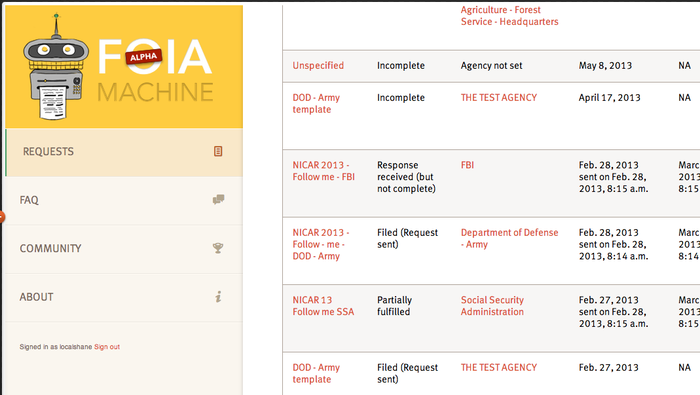
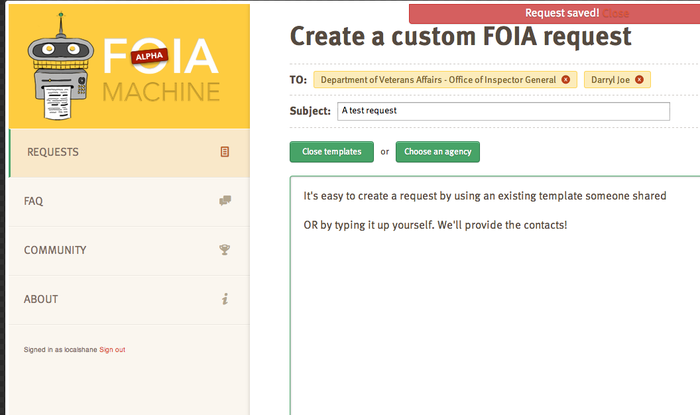
FOIA Request screen shot
Starting a FOIA request
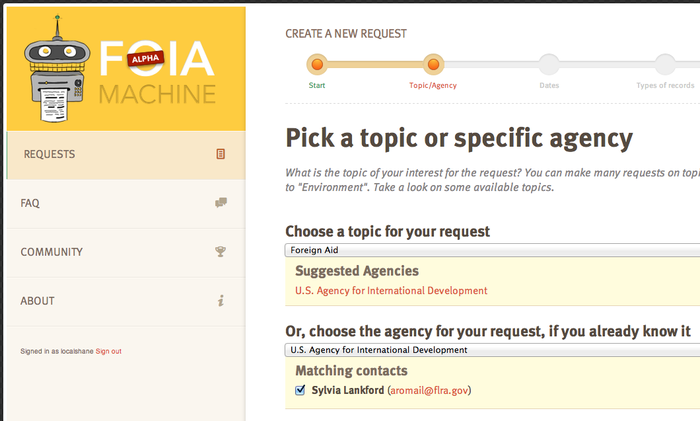
Picking a topic
That's where Kickstarter comes in: we're asking for your help to finish development, improve design and pay for servers and data curation.
We have 15 users currently sending real freedom of information requests through FOIA Machine, but almost 800 people are still waiting to use it. And when we launch, that number will grow.
Here's what we need to do to open this up to everyone:
We need to build a notification system to tell users when an agency responds to a request and to notify users when they need to follow up on outstanding requests.
We want to better track requests sent using FOIA Machine, allow users to override the status of a request, and then add data if they choose to follow up with an agency outside of FOIA Machine.
We need to expose more permissions so users can share their requests with whomever they want to.
Our designer will help smooth over some of the user interface quirks.
FOIA Machine lives on data and we need to continue adding into the database laws and information on government agencies that we're missing.
We need $55 - $150 per month, depending on traffic demands, for servers and a database.
Users will need a page to change their passwords and update their account information. We'll build that!
Oh, and it'd be great to get rid of bottlenecks that would stop us from expanding when FOIA Machine is used heavily.
Who are we?
FOIA Machine is currently housed at CIR (more about us in a minute) and is being built by a team of people working at a variety of news organizations:
Djordje Padejski is FOIA Machine's founding director and community manager. He is a founder of Serbia’s Center for Investigative Reporting and was a 2012 Knight Journalism fellow at Stanford University.
Shane Shifflett is FOIA Machine's developer and a data reporter at The Huffington Post. Before that, he was a data reporter for CIR.
Michael Corey, a news applications developer for CIR, is an advisor to FOIA Machine and occasionally contributes code to the project.
Coulter Jones is FOIA Machine's project manager and a data journalist at WNYC. Before that, he was an investigative reporter for CIR specializing in data analysis.
David Suriano is CIR's master of user interface design. He is working to make sure FOIA Machine looks good and is easy to use.
The FOIA Machine advisory group includes Chase Davis of The New York Times, David Herzog of the University of Missouri, T. Christian Miller of ProPublica, and Martha Mendoza of the Associated Press.
CIR has taken on FOIA Machine because we believe that journalism that moves citizens to action is an essential pillar of democracy. To correct injustices, people need to know what's really happening. FOIA Machine is all about bringing previously hidden information to light.
We are the only nonprofit journalism organization in the country with the in-house ability to produce stories on every available media platform – from print to video, radio and interactive data applications – making our reporting accessible and engaging and presented for maximum impact. We have worked with more than 300 news outlets, including FRONTLINE, ABC, Univision, Al-Jazeera English, The Young Turks, Stars and Stripes, the San Francisco Chronicle, KQED, NPR, The Daily Beast, CNN, YouTube and more.
CIR is home to FOIA Machine until it is ready to go public (that’s where you come in!), when it will be handed over to the national, nonprofit Investigative Reporters and Editors(IRE), which offers its hundreds of members around the world access to its extensive resource center, conferences and specialized training."
OK, so you get it? These people are for real, and this project can make a difference.
Jump in - you're be proud you did!
When mom goes to the doctor, it seems to be policy that a family member must be along to push her wheelchair. It was explained to me in terms of liability but maybe they also want a third party to listen to what the doctor is saying. They put down notes on a packet mom takes back to her care provider, but there's no substitute for ears on the ground. Or whatever.
Monday the 15th it was my turn. I met her at Bethany and rode in the van over to the doctor's (note: it's a good idea to make it clear when the van appointment's made if you're riding along, because the van coming back may not be the one going over, and maybe there wouldn't be room. Ooops!)
We got to the doctor more than half an hour early, so we went for a walk. The doctor is right next to where mom used to live, Emeritus, so we rolled over to see if anyone was there to say hello. And there was - in the room where the medical aides work, there were two people who she recognized. There were hugs all around and a lot of happy talk, catching up with people and finding out who's where.
Mom had lived at Emeritus many years, and although she had to move, it's quite difficult to miss the people you see on a daily basis. Maybe every time we go to that doctor, we should factor in a little time for a therapeutic stroll around the old place
This 1.5 credit AV CLE features Attorney Roberto Zamora who, as a law student in 2003, sued his government for violating the right to peace enshrined in Costa Rica's constitution ... and won!
As a result, the President of that nation was compelled to rescind participation in war-making.
How Zamora succeeded and further efforts to implement peace under law in a variety of legal venues is the subject of this lecture, recorded at Seattle University School of Law in June of 2013.
July 24: New Trends in the Investigation and Discovery of a Construction Defect Claim. How written discovery can assist carriers nationally in assessing risk transfer opportunities, setting meaningful reserves and defense counsel in obtaining as much insurance coverage as possible for their client. By Claims & Litigation Management Alliance.
Each of these programs can earn you credit, at no cost, in the state in which it is held.
In addition, these programs often can earn you credit in other states. If the organizer has not applied for credit in your state, check with the credit-granting authority in your state.


 July 20, 20213


 by Jacelyn Howells can help the most advanced collector or dealer, as well as the beginner. It includes:






 Register now and put them on your calendar!